
Analysis of 2026 Budget Recommendations
Please continue to check this page as further analyses and resources become available. Last updated 2/11/2026
CDC has received $9.2B in congressional appropriations each year since 2023. Although the President’s Budget proposed slashing appropriations by over half, the House and Senate committees have a different proposal. The Senate Appropriations Committee originally proposed almost level funding ($9.15B), and the House proposed a 19% cut ($7.5B, the majority of which comes from cutting HIV/AIDS prevention, global health, and chronic disease prevention). On January 20, 2026, the committees released a combined recommendation, which includes mostly level funding for CDC. As of February 3rd, 2026, this budget has been passed by the U.S. Congress and approved by the President. It is important that we hold the agencies accountable for dispersing funds as appropriated.
Congress didn't include any money for AHA in any of their bills or reports. Staffers on committees with jurisdiction over HHS told NPR there have not even been meetings with Kennedy's staff to “help secure support for new funding or authorization to stand up the new agency in the future,” and that “lack of engagement with Congress… also shows in Kennedy's disregard for lawmakers' intent when he eliminated staff and programs during the DOGE-fueled firings in April 2025.”
However, HHS has been using all available loopholes to make AHA happen, follow the President’s Budget, and subvert the will of Congress, including:
Not posting any fiscal year (FY) 2026 grant funding announcements for chronic, HIV/AIDS, viral hepatitis, STDs, or tuberculosis prevention
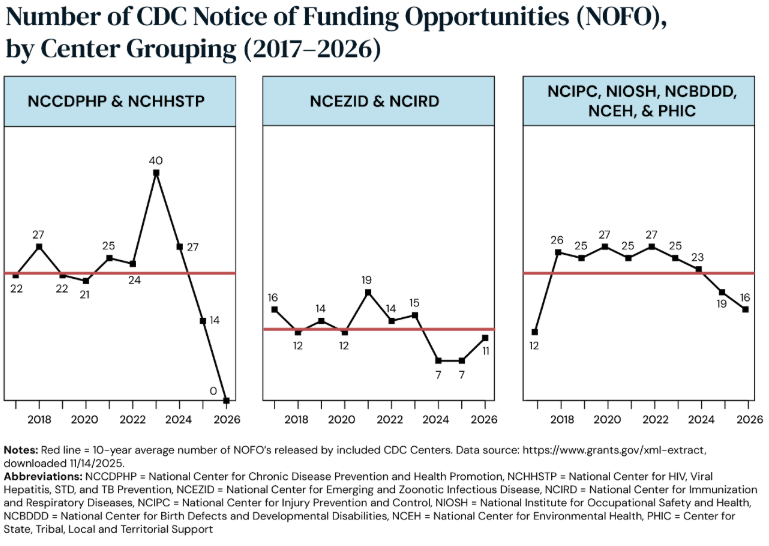
Halting the flow of funds and disrupting normal funding cycles for programs slated for cuts in AHA plans.
Terminating CDC grants to CA, MN, CO, and IL.
Eliminating Center leadership, leaving only 20% of original Center directors.
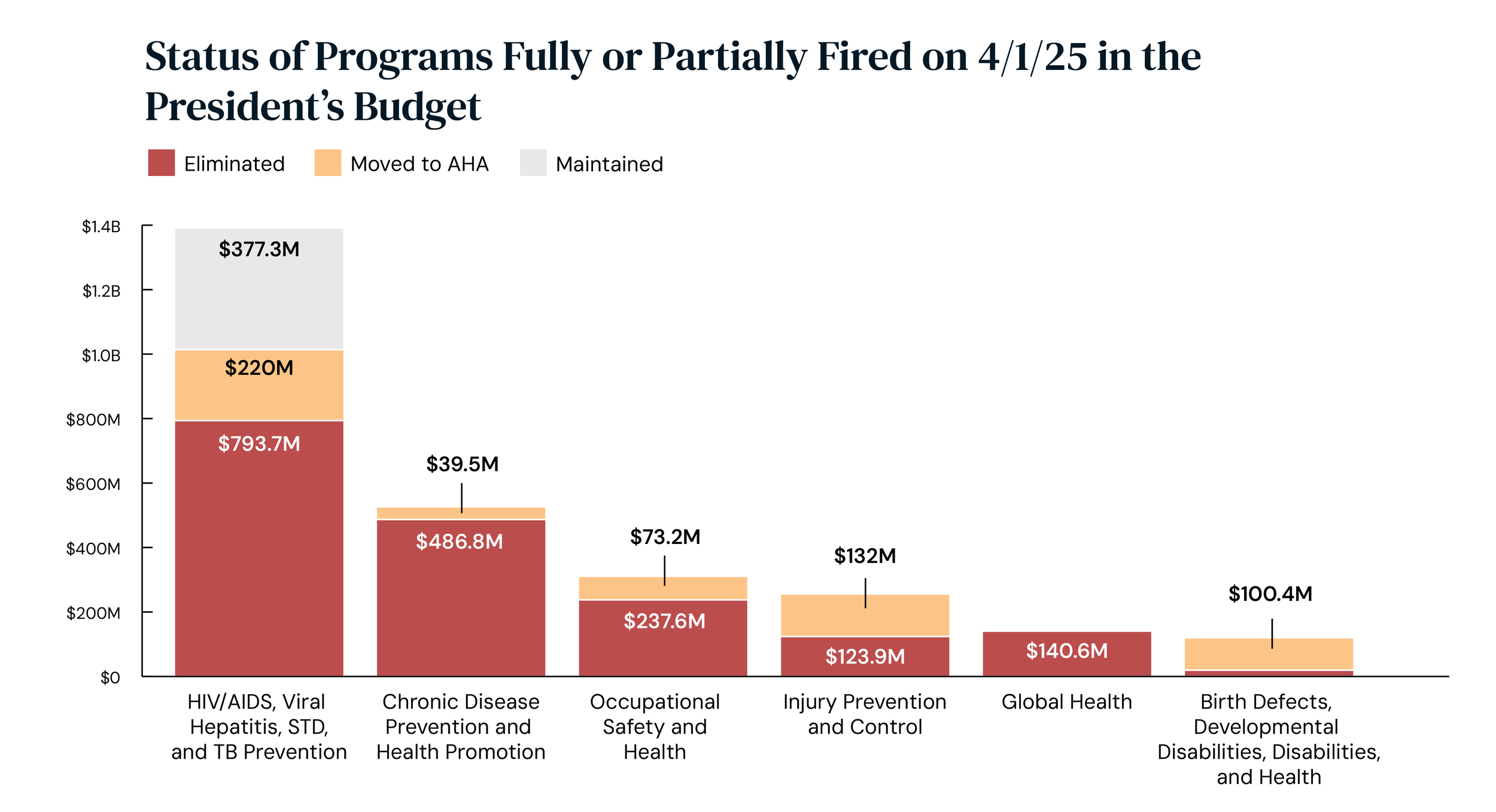
Firing entire subprograms within programs slated for elimination, even though Congress fully funded them. Of the offices that were RIF’d on April 1, 2025 completely or partially, 87% were either slated for elimination (66%) or to move to AHA (21%) in the President’s Budget.
In depth budget analysis: Congressional safeguards
Although it is unclear how these Congressional plans will be implemented, it is clear that neither side of the aisle in Congress is supportive of the extent of firings, President’s proposed and implemented funding cuts, or reorganization without Congressional approval.
The table below compares budget lines from fiscal year (FY) 25 Current Program Budget, the FY26 Proposed President’s Budget, the FY26 Congressional Budget as outlined in the Jan 20, 2026 Joint Explanatory Statement, and the difference between Congress’ proposal and the current budget.
Congress included a number of provisions regarding use of HHS funding in the final bill HR7148, the Joint Explanatory Statement, the House Appropriations Committee Report, and the Senate Appropriations Committee Report. The Joint Explanatory Statement specifically instructs agencies to follow the guidance in all of these documents when implementing the bill:
“In providing the operating plan required by section 516 of this Act, the Departments and agencies funded in this Act are directed to include all programs, projects, and activities, including those in House Report 119-271, Senate Report 119-55, and this explanatory statement accompanying this Act. All such programs, projects, and activities are subject to the provisions of this Act.” p. 1
Within final bill HR7148, Congress directs HHS to provide sufficient staffing levels:
“SEC. 239. The Department of Health and Human Services shall support staffing levels necessary to fulfill its statutory responsibilities including carrying out programs, projects, and activities funded in this title of this Act in a timely manner: Provided, That the Secretary shall submit a detailed plan and justification to the Committees on Appropriations of the House of Representatives and the Senate, and make publicly available to allow for an independent review not less than 60 days prior to initiating the execution of any reorganization moving functions, pursuant to any authorities otherwise provided, carried out by the Centers for Disease Control and Prevention to another component of the Department of Health and Human Services, relative to how such functions are funded in this Act.” p. 120
The Senate Appropriations Committee Report specifically instructs HHS to return to pre-RIF staffing levels for the Safe Motherhood and Infant Health line, which is associated with the Division of Reproduce Health and faced entire elimination of multiple branches:
“Safe Motherhood and Infant Health.—The Committee includes a $3,000,000 increase for this portfolio of programs to improve the health of pregnant and postpartum individuals and their infants. The CDC is directed to maintain the same level of staff in the Safe Motherhood Office as were in place on March 31, 2025.” p. 83
The table below depicts provisions from the Joint Explanatory Statement for HHS. For example, Congress directs HHS to provide timely public reporting and briefings, adds safeguards requiring HHS to consult Congress before terminating grants, and requires advance notice and timely processing when implementing payment system changes that could delay funds. A number of program-specific provisions are also detailed below.
How all of these funding and staffing provisions will be implemented within HHS operating plans remains to be seen.